Recently, with the recovery of the cultural and tourism industry and the normalization of commercial activities, steel Layher stages have rapidly become the preferred construction solution for concerts, weddings, roadshows, and campus events due to their superior structural stability and high cost-effectiveness. Data shows that in 2026, the market share of steel Layher stages in small and medium-sized events in China exceeded 75%, and the usage rate for large-scale outdoor performances reached 90%. Its dual advantages of "safety and reliability + cost-effectiveness" are reshaping the stage equipment industry landscape.
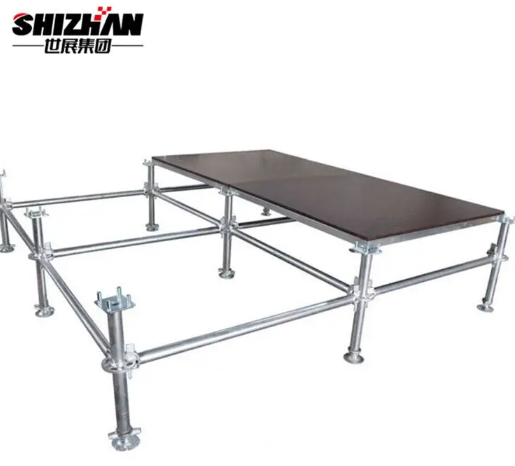
The core competitiveness of Steel Layar Stage stems from its stringent material selection and structural design. Mainstream products utilize Q355B high-strength steel as the main material for the uprights, with a pipe diameter of φ48mm and a wall thickness ≥3.25mm. A single upright can withstand a maximum load of 6 tons, with a uniform load-bearing capacity exceeding 500kg per square meter, easily supporting the dynamic pressure of large LED screens, audio equipment, and dense crowds. The unique disc-lock self-locking structure and three-dimensional mesh distribution design ensure even stress distribution at each node. Combined with fully fitted diagonal braces, this forms a stable triangular support system, capable of withstanding winds of up to level 8. Even in complex environments such as level 5 gusts or 15-degree slopes, it maintains unwavering stability.
In terms of manufacturing processes, the stage frame is treated with hot-dip galvanizing or high-temperature electrophoresis, with a zinc layer thickness of ≥85μm. Its outdoor service life can reach over 10 years, effectively solving the problems of traditional stages being prone to rust and deformation. The application of fully automated robotic welding technology ensures smooth welds without any incomplete welds. After hundreds of thousands of disassembly and assembly tests, there is still no risk of breakage. It has achieved a zero-accident record in hundreds of large-scale events, including the Strawberry Music Festival and Jay Chou's world tour.
Compared to traditional truss stages and folding stages, steel Layher stages offer a significant advantage in terms of cost-effectiveness. Currently, the price of a nationally compliant steel Layher stage is far lower than that of an aluminum alloy stage, while its load-bearing capacity is increased by more than 30%. Its modular design allows for the interchangeability of parts, and one set of equipment can be adapted to various standard units such as 1.22m×1.22m and 1.22m×2.44m, supporting height adjustment from 0.6m to 1.3m. It can meet the needs of small indoor ceremonies as well as build outdoor main stages of tens of thousands of square meters.
The reduced setup and operating costs further highlight its cost-effectiveness. No professional welders or power tools are required; 3-5 workers can complete the setup of a 100㎡ stage in 4 hours. Disassembled parts can be reused, and a single set of equipment can serve more than ten events during peak season. The cost per use is as low as 3% of the purchase price. Compared to traditional welded stages, steel Layher scaffolding can save more than 50% of setup time and labor costs, and venue rental costs are also reduced, making it particularly popular with small and medium-sized event companies and wedding agencies.
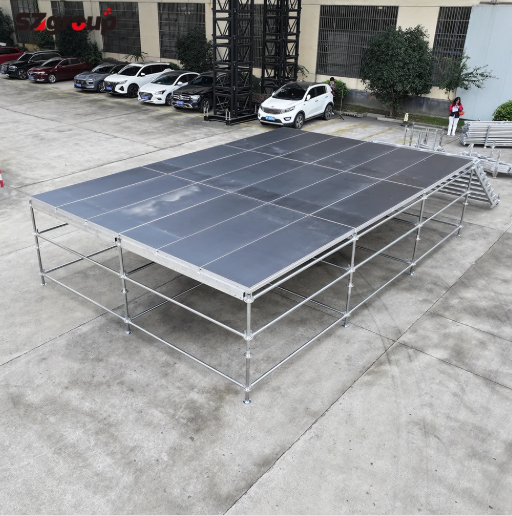
The flexibility of the steel Layar stage allows it to transcend scene limitations. On flat sites, a large main stage and multi-tiered seating can be erected. In complex terrains such as mountains and grasslands, millimeter-level leveling can be achieved through adjustable bases. The 2025 Guizhou Mountain Music Festival successfully constructed a 2000㎡ stage on a 15-degree slope. In addition to the core performance area, it can also be extended to include lighting and sound rigs, LED screen supports, performer walkways, and other auxiliary structures, achieving integrated stage system construction and providing more creative space for stage design.
Industry experts say that as stage safety standards become increasingly stringent, non-standard stage products will gradually be phased out of the market. Steel Layher stages, which meet national standards such as JG/T 503-2016 and GB/T 36731-2018, will continue to dominate the event setup market due to their core advantages of "undiminished sturdiness and controllable costs." In the future, with the iteration of intelligent monitoring technology and environmentally friendly processes, steel Layher stages are expected to achieve breakthroughs such as real-time visualization of safety data and improved material recycling rates, providing stronger support for the high-quality development of the cultural and performing arts industry.
 Hot News
2024-08-21
2024-01-07
2018-10-18

Welcome to SZgroup(SHIZHAN), the direct manufacturer for top truss stage brands in the world with 24 years experience!
80# Xixin Road, Xibei Town, Xishan District, Wuxi, Jiangsu, China
Copyright © Jiangsu Shizhan Group Co., Ltd. All Rights Reserved - Privacy Policy - Blog
 EN
EN